Computational Game Theory- From Formulation to Equilibrium
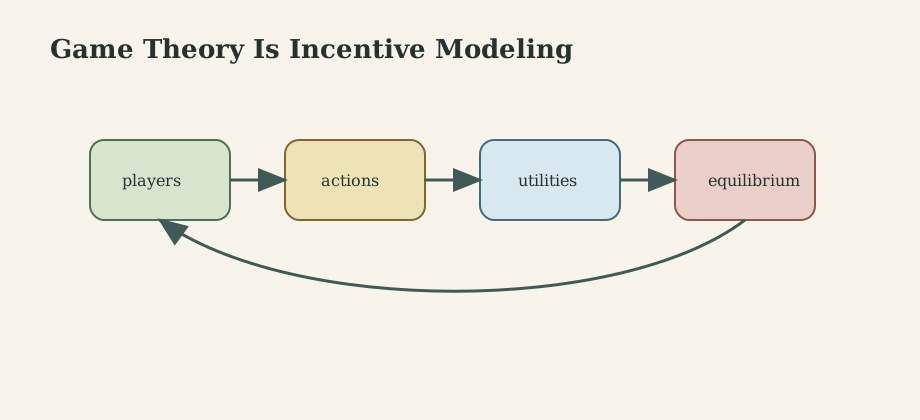
1. What Is a Game?
A strategic (normal-form) game is a tuple
\[\Gamma = \langle N,\;(A_i)_{i\in N},\;(u_i)_{i\in N}\rangle\]where
| Symbol | Meaning |
|---|---|
| $N = {1,\dots,n}$ | finite set of players |
| $A_i$ | action (strategy) set of player $i$ |
| $A = A_1 \times \cdots \times A_n$ | joint action space |
| $u_i : A \to \mathbb{R}$ | utility (payoff) function of player $i$ |
Each player picks an action simultaneously; the outcome depends on the entire profile $a = (a_1,\dots,a_n) \in A$.
Key modelling insight. The utility $u_i$ encodes everything player $i$ cares about — reward, cost, risk, fairness — so utility engineering is as important as algorithm design.
2. Dominant Strategies and Elimination
Definition (Strict dominance). Action $a_i$ is strictly dominated by $a_i’$ if
\[u_i(a_i', a_{-i}) > u_i(a_i, a_{-i}) \quad \forall\, a_{-i} \in A_{-i}.\]A rational player never plays a strictly dominated action. We can therefore iteratively eliminate dominated strategies (IESDS) to simplify the game; the order of elimination does not matter for strict dominance.
Example: Prisoner’s Dilemma
| C (cooperate) | D (defect) | |
|---|---|---|
| C | $(-1,-1)$ | $(-3,\;0)$ |
| D | $(0,-3)$ | $(-2,-2)$ |
For Player 1: $u_1(D,C)=0 > -1 = u_1(C,C)$ and $u_1(D,D)=-2 > -3 = u_1(C,D)$, so $D$ strictly dominates $C$. By symmetry the same holds for Player 2.
\[\Rightarrow \text{Unique outcome: } (D,D) \text{ with payoffs } (-2,-2).\]Both players could do better at $(C,C)$, but unilateral deviation from $C$ is profitable — the core tension game theory formalises.
Prisoner’s Dilemma normal form. Source: Wikimedia Commons, CC BY-SA 3.0.
3. Best Response and Nash Equilibrium
3.1 Best Response
Given opponents’ actions $a_{-i}$, player $i$’s best response set is
\[BR_i(a_{-i}) = \arg\max_{a_i \in A_i}\; u_i(a_i, a_{-i}).\]3.2 Pure Nash Equilibrium (PNE)
A profile $a^* = (a_1^,\dots,a_n^)$ is a Nash equilibrium if every player is simultaneously best-responding:
\[\boxed{a_i^* \in BR_i(a_{-i}^*) \quad \forall\, i \in N}\]Equivalently, no player can improve by deviating unilaterally:
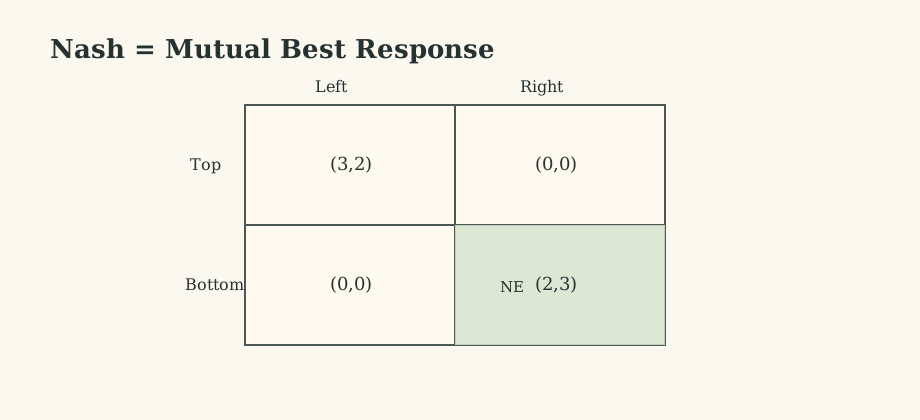
\[u_i(a_i^*, a_{-i}^*) \geq u_i(a_i, a_{-i}^*) \quad \forall\, a_i \in A_i,\;\forall\, i.\]Example: Coordination Game (Battle of the Sexes)
| Opera | Football | |
|---|---|---|
| Opera | $(3,2)$ | $(0,0)$ |
| Football | $(0,0)$ | $(2,3)$ |
Check $(O,O)$: Player 1 gets 3 vs 0 if deviating → no incentive. Player 2 gets 2 vs 0 → no incentive. NE.
Check $(F,F)$: Player 1 gets 2 vs 0 → no incentive. Player 2 gets 3 vs 0 → no incentive. NE.
Check $(O,F)$: Player 1 gets 0, could switch to $F$ and get 2 → deviation profitable. Not NE.
Multiple NE are common and create a coordination problem: which one will the players settle on?
4. Mixed Strategies and Nash’s Theorem
Not every game has a PNE (e.g., Matching Pennies). We extend to mixed strategies.
4.1 Mixed Strategy
A mixed strategy for player $i$ is a probability distribution $\sigma_i \in \Delta(A_i)$, where $\sigma_i(a_i)$ is the probability of playing $a_i$.
Expected utility under a mixed profile $\sigma = (\sigma_1,\dots,\sigma_n)$:
\[U_i(\sigma) = \sum_{a \in A} \left(\prod_{j=1}^{n} \sigma_j(a_j)\right) u_i(a).\]4.2 Indifference Principle
At a mixed NE, every action in the support of $\sigma_i^*$ must yield the same expected payoff. If some action gave strictly more, the player would shift all probability mass to it.
\[\text{If } \sigma_i^*(a_i) > 0 \text{ and } \sigma_i^*(a_i') > 0, \text{ then } U_i(a_i, \sigma_{-i}^*) = U_i(a_i', \sigma_{-i}^*).\]4.3 Derivation: Matching Pennies
| H | T | |
|---|---|---|
| H | $(1,-1)$ | $(-1,1)$ |
| T | $(-1,1)$ | $(1,-1)$ |
Let Player 2 play $H$ with probability $q$. Player 1’s expected payoffs:
\[U_1(H, q) = q(1) + (1-q)(-1) = 2q - 1\] \[U_1(T, q) = q(-1) + (1-q)(1) = 1 - 2q\]For Player 1 to be willing to mix, we need indifference:
\[2q - 1 = 1 - 2q \;\;\Longrightarrow\;\; 4q = 2 \;\;\Longrightarrow\;\; q^* = \tfrac{1}{2}\]By symmetry, Player 1 also mixes $p^* = \tfrac{1}{2}$.
\[\boxed{\sigma^* = \left(\tfrac{1}{2}H + \tfrac{1}{2}T,\;\tfrac{1}{2}H + \tfrac{1}{2}T\right), \quad U_i(\sigma^*) = 0}\]4.4 Nash’s Existence Theorem
Theorem (Nash, 1950). Every finite game (finite $N$, finite $A_i$) has at least one mixed-strategy Nash equilibrium.
The proof uses Kakutani’s fixed-point theorem on the best-response correspondence $BR: \Delta(A) \rightrightarrows \Delta(A)$, which is non-empty, convex-valued, and upper hemicontinuous when utilities are continuous and action sets are compact convex.
5. Deriving Equilibrium in $2 \times 2$ Games (General Method)
Consider a general $2 \times 2$ game:
| L | R | |
|---|---|---|
| T | $(a_{11}, b_{11})$ | $(a_{12}, b_{12})$ |
| B | $(a_{21}, b_{21})$ | $(a_{22}, b_{22})$ |
Let Player 1 play $T$ with probability $p$, Player 2 play $L$ with probability $q$.
Step 1: Indifference for Player 2 (to find $p^*$).
Player 2 is indifferent between $L$ and $R$:
\[p\, b_{11} + (1-p)\, b_{21} = p\, b_{12} + (1-p)\, b_{22}\] \[\Longrightarrow \quad p^* = \frac{b_{22} - b_{21}}{(b_{11} - b_{12}) - (b_{21} - b_{22})}\]Step 2: Indifference for Player 1 (to find $q^*$).
\[q\, a_{11} + (1-q)\, a_{12} = q\, a_{21} + (1-q)\, a_{22}\] \[\Longrightarrow \quad q^* = \frac{a_{22} - a_{12}}{(a_{11} - a_{21}) - (a_{12} - a_{22})}\]If $p^,q^ \in (0,1)$, a strictly mixed NE exists. Pure NE correspond to corner solutions $(p,q) \in {0,1}^2$.
6. Correlated Equilibrium
A correlated equilibrium (CE) generalises NE by allowing a mediator to privately recommend actions to each player. Formally:
Let $\pi$ be a distribution over $A$. The mediator draws $a \sim \pi$ and tells player $i$ only their component $a_i$. This is a CE if no player gains from deviating:
\[\boxed{\sum_{a_{-i}} \pi(a_i, a_{-i})\bigl[u_i(a_i, a_{-i}) - u_i(a_i', a_{-i})\bigr] \geq 0 \quad \forall\, i,\; \forall\, a_i \in \text{supp}_i(\pi),\; \forall\, a_i' \in A_i}\]Why CE matters:
- Every NE is a CE (product distributions are special cases).
- CE can achieve higher social welfare than any NE.
- CE can be computed by linear programming (the constraints above are linear in $\pi$), whereas finding NE is PPAD-complete in general.
Example: Traffic Intersection
Two drivers approach an intersection. If both go, they crash (payoff $-10$). If one goes and the other waits, the goer gets $1$, the waiter gets $0$.
| Go | Wait | |
|---|---|---|
| Go | $(-10,-10)$ | $(1,0)$ |
| Wait | $(0,1)$ | $(0,0)$ |
Pure NE: $(Go, Wait)$ and $(Wait, Go)$. Mixed NE gives positive crash probability.
A traffic light (correlated signal) recommends (Go, Wait) and (Wait, Go) each with probability $\tfrac{1}{2}$:
\[\pi(Go,Wait) = \pi(Wait,Go) = \tfrac{1}{2}.\]Expected payoff per player: $\tfrac{1}{2}(1) + \tfrac{1}{2}(0) = 0.5$. No crash. This CE is better than the mixed NE — the signal coordinates.
7. Bayesian Games and Incomplete Information
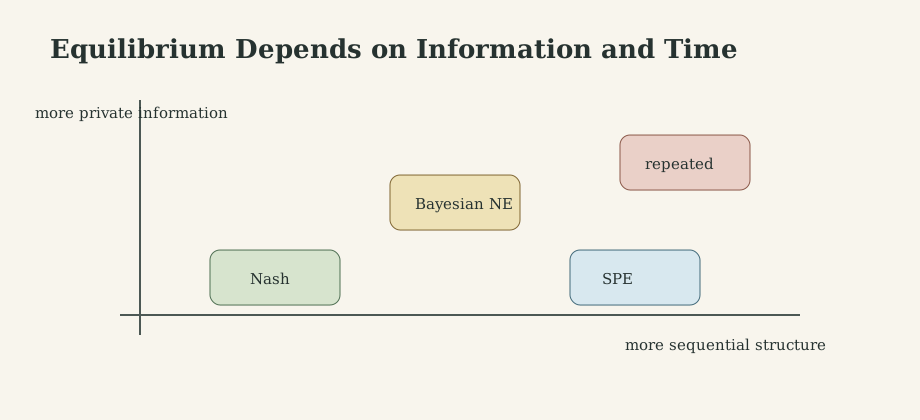
When players have private types (hidden costs, capabilities, preferences), we model this as a Bayesian game:
\[\Gamma^B = \langle N,\;(A_i),\;(\Theta_i),\;(u_i),\;p \rangle\]where $\Theta_i$ is the type space of player $i$, and $p$ is a common prior over $\Theta = \Theta_1 \times \cdots \times \Theta_n$.
A Bayesian Nash Equilibrium (BNE) is a strategy profile $s^* = (s_1^,\dots,s_n^)$ where $s_i^*: \Theta_i \to A_i$ and:
\[\boxed{s_i^*(\theta_i) \in \arg\max_{a_i \in A_i} \sum_{\theta_{-i}} p(\theta_{-i}|\theta_i)\, u_i(a_i,\, s_{-i}^*(\theta_{-i}),\, \theta_i,\, \theta_{-i}) \quad \forall\, \theta_i}\]Each player maximises expected utility over others’ types, given their own type and beliefs.
Example: First-Price Sealed-Bid Auction
Two bidders with private valuations $v_i \sim \text{Uniform}[0,1]$, independent. Highest bidder wins, pays own bid $b_i$. Utility:
\[u_i(b_i, b_{-i}, v_i) = \begin{cases} v_i - b_i & \text{if } b_i > b_{-i} \\ 0 & \text{if } b_i < b_{-i} \end{cases}\]Deriving the BNE. Conjecture symmetric linear strategies: $b_j(v_j) = \alpha v_j$.
Player $i$’s expected utility from bidding $b_i$:
\[\mathbb{E}[u_i] = (v_i - b_i)\, \Pr(b_i > \alpha v_j) = (v_i - b_i)\, \Pr\!\left(v_j < \frac{b_i}{\alpha}\right) = (v_i - b_i)\,\frac{b_i}{\alpha}\]Maximise over $b_i$:
\[\frac{d}{d b_i}\left[\frac{b_i(v_i - b_i)}{\alpha}\right] = \frac{v_i - 2b_i}{\alpha} = 0 \quad\Longrightarrow\quad b_i^* = \frac{v_i}{2}\]This gives $\alpha = \tfrac{1}{2}$, confirming the conjecture. In equilibrium, each bidder bids half their valuation — they shade their bid to extract surplus.
\[\boxed{b_i^*(v_i) = \frac{v_i}{2} \quad \text{(BNE of 2-player first-price auction)}}\]For $n$ bidders the result generalises to $b_i^*(v_i) = \frac{n-1}{n}\,v_i$.
8. Extensive-Form Games and Subgame Perfection
An extensive-form game models sequential decisions via a game tree.
Example game tree with branching decisions and terminal payoffs. Source: Wikimedia Commons, CC BY-SA 3.0.
8.1 Subgame Perfect Equilibrium (SPE)
Nash equilibrium in extensive form can involve non-credible threats — a player threatens an action they would never actually carry out. SPE eliminates this:
A strategy profile is a subgame perfect equilibrium if it induces a Nash equilibrium in every subgame.
We find SPE by backward induction: solve from the terminal nodes upward.
Example: Entry Deterrence
- Stage 1: Entrant chooses Enter or Stay Out.
- Stage 2: If entry occurs, Incumbent chooses Fight ($(-1,-1)$) or Accommodate ($(1,1)$).
Backward induction: At stage 2, Incumbent prefers Accommodate ($1 > -1$). Knowing this, Entrant enters ($1 > 0$).
\[\text{SPE: (Enter, Accommodate)} \quad \text{payoffs } (1,1).\]The “threat to fight” is not credible — once entry happens, fighting hurts the Incumbent too.
8.2 One-Deviation Principle
To verify SPE in finite games, it suffices to check that no player can improve by deviating at exactly one decision node (keeping future strategy the same). This reduces verification from exponential to linear in the tree size.
9. Repeated Games and Cooperation
When a stage game $G$ is played repeatedly (possibly infinitely), richer strategic behaviour emerges.
9.1 Discount Factor and Payoffs
With discount factor $\delta \in [0,1)$, the discounted average payoff from a stream $(u^0, u^1, u^2, \dots)$ is:
\[V_i = (1-\delta)\sum_{t=0}^{\infty} \delta^t\, u_i^t\]9.2 The Folk Theorem (Informal)
If $\delta$ is sufficiently close to 1, any feasible payoff vector that gives each player more than their minimax value can be sustained as a (subgame perfect) equilibrium of the infinitely repeated game.
The minimax value for player $i$:
\[\underline{v}_i = \min_{a_{-i}} \max_{a_i} u_i(a_i, a_{-i})\]This is the lowest payoff others can force on player $i$ when $i$ plays optimally.
9.3 Deriving the Threshold: Grim Trigger in Prisoner’s Dilemma
Using the payoff matrix from Section 2, consider the Grim Trigger strategy: cooperate initially; if anyone defects, defect forever.
Cooperation payoff stream: $-1$ every period.
\[V_i^{\text{coop}} = (1-\delta)\sum_{t=0}^{\infty}\delta^t(-1) = -1\]Deviation payoff stream: deviation yields $0$ today, then $-2$ forever (punished by both playing $D$).
\[V_i^{\text{dev}} = (1-\delta)\Bigl[0 + \delta(-2) + \delta^2(-2) + \cdots\Bigr] = (1-\delta)\cdot\frac{-2\delta}{1-\delta} = -2\delta\]Cooperation is sustainable iff:
\[V_i^{\text{coop}} \geq V_i^{\text{dev}} \quad\Longrightarrow\quad -1 \geq -2\delta \quad\Longrightarrow\quad \boxed{\delta \geq \frac{1}{2}}\]When players are patient enough ($\delta \geq \frac{1}{2}$), the threat of perpetual punishment makes cooperation self-enforcing — even without binding contracts.
10. Potential Games
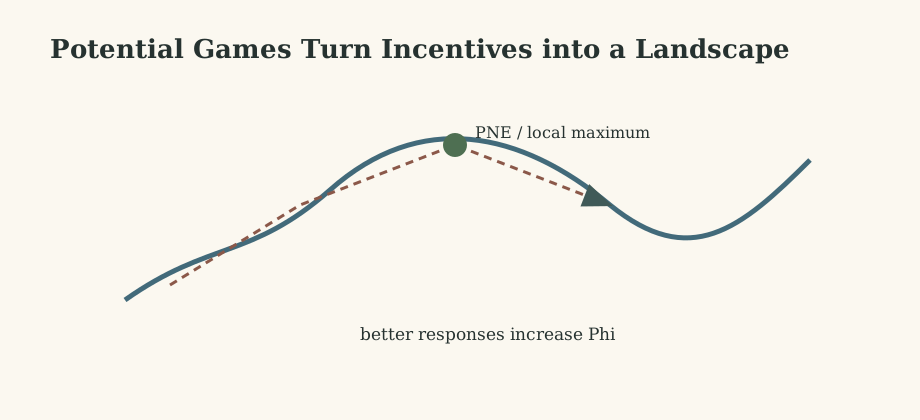
A game has an exact potential function $\Phi: A \to \mathbb{R}$ if, for every player $i$, changing $i$’s action while others stay fixed changes $\Phi$ by the same amount as $i$’s utility:
\[\boxed{u_i(a_i', a_{-i}) - u_i(a_i, a_{-i}) = \Phi(a_i', a_{-i}) - \Phi(a_i, a_{-i}) \quad \forall\, i,\;a_i,a_i',a_{-i}}\]Why Potential Games Are Computationally Attractive
- PNE exist — any maximiser of $\Phi$ is a PNE.
- Best-response dynamics converge — each best-response strictly increases $\Phi$ (finite improvement property).
- Decentralised optimisation — players independently maximising their own $u_i$ collectively climb $\Phi$.
Example: Congestion Game
$n$ players choose among resources $E$. Each resource $e$ has a cost $c_e(x_e)$ depending on congestion $x_e$ (number of users). Player $i$ chooses a subset $S_i \subseteq E$ and pays:
\[u_i(S_i, S_{-i}) = -\sum_{e \in S_i} c_e(x_e)\]Rosenthal’s potential:
\[\Phi(S_1,\dots,S_n) = -\sum_{e \in E}\sum_{k=1}^{x_e} c_e(k)\]Verification. When player $i$ switches from resource $e$ to $e’$:
- Potential change from dropping $e$: removes $c_e(x_e)$ from the sum → $\Delta\Phi = +c_e(x_e)$.
- Potential change from adding $e’$: adds $c_{e’}(x_{e’}+1)$ → $\Delta\Phi = -c_{e’}(x_{e’}+1)$.
- Utility change = same. ✓
This proves every congestion game is an exact potential game with guaranteed PNE.
Price of Anarchy in Congestion Games
The Price of Anarchy (PoA) measures equilibrium inefficiency:
\[\text{PoA} = \frac{\text{Social welfare at worst NE}}{\text{Optimal social welfare}} = \frac{\min_{a^*\in \text{NE}} \sum_i u_i(a^*)}{\max_a \sum_i u_i(a)}\]For linear congestion games ($c_e(x) = a_e x + b_e$), the PoA is bounded by $\frac{5}{2}$ — decentralised behaviour is at most 2.5× worse than optimal. This bound is tight.
11. Supermodular Games and Monotone Dynamics
A game is supermodular if actions are strategic complements: when opponents increase their actions, a player’s best response weakly increases too.
Formally, with ordered action sets, the game is supermodular if $u_i$ has increasing differences:
\[u_i(a_i', a_{-i}') - u_i(a_i, a_{-i}') \geq u_i(a_i', a_{-i}) - u_i(a_i, a_{-i}) \quad \text{for } a_i' \geq a_i,\; a_{-i}' \geq a_{-i}\]Key Results
- Extremal NE exist: iterating best responses from the lattice minimum $\underline{a}$ converges monotonically to the smallest NE $\underline{a}^$; from the maximum $\bar{a}$ converges to the largest NE $\bar{a}^$.
- Comparative statics: if a parameter shifts payoffs upward, equilibria shift upward — useful for policy analysis.
Example: Technology Adoption
$n$ firms each choose investment level $a_i \in [0, \bar{a}]$. The more others invest, the more valuable one’s own investment (network effects):
\[u_i(a_i, a_{-i}) = a_i \cdot f\!\left(\sum_{j\neq i} a_j\right) - c(a_i)\]where $f$ is increasing (strategic complementarity) and $c$ is convex cost. Increasing differences hold because $\frac{\partial^2 u_i}{\partial a_i \,\partial a_j} = f’(\cdot) > 0$.
12. Mechanism Design: Engineering the Rules
Mechanism design inverts game theory: instead of analysing a given game, we design the rules so that strategic behaviour produces desired outcomes.
12.1 Setup
- Players have private types $\theta_i \in \Theta_i$ (e.g., valuations).
- Social choice function $f: \Theta \to X$ maps type profiles to outcomes.
- A mechanism $(M, g)$ specifies message spaces $M_i$ and an outcome function $g: M \to X$.
- $f$ is implementable if there exists a mechanism where equilibrium play produces $f(\theta)$ for all $\theta$.
12.2 VCG (Vickrey-Clarke-Groves) Mechanism
The VCG mechanism achieves efficient outcomes under quasi-linear utilities $u_i(x, \theta_i) = v_i(x, \theta_i) - t_i$:
Allocation: Choose the efficient outcome:
\[x^*(\hat{\theta}) = \arg\max_x \sum_{i} v_i(x, \hat{\theta}_i)\]Payment (Clarke pivot rule):
\[\boxed{t_i = \max_x \sum_{j \neq i} v_j(x, \hat{\theta}_j) - \sum_{j \neq i} v_j(x^*(\hat{\theta}), \hat{\theta}_j)}\]Truthfulness derivation. Under truthful reporting ($\hat{\theta}_i = \theta_i$), player $i$’s net utility is:
\[u_i = v_i(x^*, \theta_i) - t_i = v_i(x^*, \theta_i) + \sum_{j\neq i} v_j(x^*, \hat{\theta}_j) - \max_x \sum_{j\neq i} v_j(x, \hat{\theta}_j)\] \[= \sum_j v_j(x^*, \theta) - \underbrace{\max_x \sum_{j\neq i} v_j(x, \hat{\theta}_j)}_{\text{constant w.r.t. } \hat{\theta}_i}\]Since the subtracted term doesn’t depend on $i$’s report, player $i$ maximises personal utility by maximising $\sum_j v_j(x^*, \theta)$ — which requires $\hat{\theta}_i = \theta_i$. Truthful reporting is a dominant strategy.
Example: Second-Price Auction (Vickrey Auction)
Single item, $n$ bidders. In VCG: winner is highest bidder, payment equals second-highest bid.
Bidder with value $v_i$: bidding $v_i$ is weakly dominant regardless of others’ strategies. Underbidding risks losing when $b_2 < v_i$; overbidding risks winning when $b_2 > v_i$ (negative surplus).
13. Coalitional (Cooperative) Games
When players can form binding coalitions and share surplus, we use transferable-utility (TU) coalitional games:
\[(N, v) \quad \text{where } v: 2^N \to \mathbb{R}, \;\; v(\emptyset) = 0\]$v(S)$ is the worth of coalition $S$ — the total payoff $S$ can guarantee itself.
13.1 The Core
An allocation $x = (x_1,\dots,x_n)$ with $\sum_i x_i = v(N)$ is in the core if no coalition can do better:
\[\boxed{\sum_{i \in S} x_i \geq v(S) \quad \forall\, S \subseteq N}\]The core may be empty (no stable allocation exists). It is non-empty iff the game is balanced (Bondareva-Shapley theorem).
13.2 Shapley Value
The Shapley value allocates payoff based on average marginal contribution:
\[\boxed{\phi_i(v) = \sum_{S \subseteq N \setminus \{i\}} \frac{|S|!\,(n-|S|-1)!}{n!}\;\bigl[v(S \cup \{i\}) - v(S)\bigr]}\]It is the unique allocation satisfying efficiency, symmetry, dummy player, and additivity axioms.
Example: Airport Runway Cost Sharing
Three airlines need runways of different lengths: $v({1})=60$, $v({2})=90$, $v({3})=120$, and $v(S)=\max_{i\in S} v({i})$ (only one runway is built for the longest need).
Marginal contributions of Player 3 to all coalitions:
| Coalition $S$ | $v(S)$ | $v(S \cup {3})$ | Marginal |
|---|---|---|---|
| $\emptyset$ | 0 | 120 | 120 |
| ${1}$ | 60 | 120 | 60 |
| ${2}$ | 90 | 120 | 30 |
| ${1,2}$ | 90 | 120 | 30 |
The largest plane pays the most but not the full cost — a principled cost-sharing rule.
14. Learning in Games
When players don’t know others’ strategies, they learn through repeated play.
14.1 Fictitious Play
Each player maintains empirical frequencies of opponents’ past actions and best-responds to those beliefs:
\[\hat{\sigma}_{-i}^{(t)}(a_{-i}) = \frac{1}{t}\sum_{\tau=1}^{t} \mathbb{1}[a_{-i}^{(\tau)} = a_{-i}]\] \[a_i^{(t+1)} \in \arg\max_{a_i} U_i(a_i, \hat{\sigma}_{-i}^{(t)})\]Convergence: guaranteed in $2\times 2$ games, zero-sum games, potential games, and supermodular games. May cycle otherwise.
14.2 No-Regret Learning
A player uses a no-regret algorithm if the external regret vanishes:
\[R_i^T = \max_{a_i \in A_i} \sum_{t=1}^{T} u_i(a_i, a_{-i}^{(t)}) - \sum_{t=1}^{T} u_i(a_i^{(t)}, a_{-i}^{(t)}) \quad\Longrightarrow\quad \frac{R_i^T}{T} \to 0\]Key result: If all players use no-regret algorithms, the time-averaged joint strategy converges to a coarse correlated equilibrium — a computationally attractive solution concept.
15. Multi-Agent Systems Application: Where It All Connects
The theory directly applies to multi-robot and multi-agent coordination:
| Problem | Game Model | Equilibrium Concept |
|---|---|---|
| Task allocation | Congestion / assignment game | PNE via potential function |
| Path deconfliction | Local coupling game | Better-response dynamics |
| Charging scheduling | Shared-resource game | Correlated equilibrium (signal = schedule) |
| Communication relay | Role-assignment game | Mechanism design (VCG-like bidding) |
| Formation control | Continuous-action game | Gradient-based NE computation |
Swarm robotics: coordination, congestion management, and resource scheduling. Source: Wikimedia Commons, CC BY-SA 3.0.
Design Principles for Multi-Agent Game-Theoretic Systems
- Exploit structure first. Check if your game is potential, congestion, or supermodular — this determines solver choice.
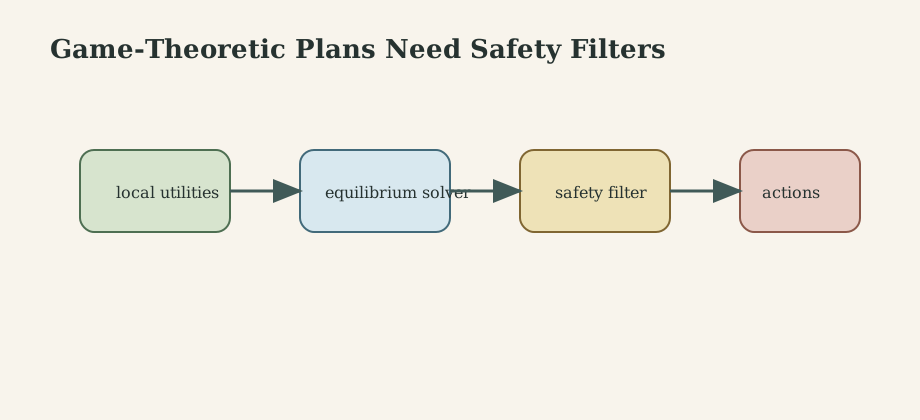
- Safety as hard constraint. Game-theoretic outputs are candidate plans; a safety filter (e.g., control barrier function) must independently verify.
- Asynchronous updates. Synchronous best-response can oscillate; asynchronous better-response with inertia is more robust.
- Measure PoA empirically. Compare decentralised outcome to centralised optimum to quantify the “cost of autonomy.”
- Fairness by design. Include burden-tracking terms in utilities to rotate costly roles (relay duty, hazard inspection).
Summary of Equilibrium Concepts
| Concept | Setting | Key Property |
|---|---|---|
| Nash (Pure) | Normal form | No unilateral profitable deviation |
| Nash (Mixed) | Normal form | Existence guaranteed (finite games) |
| Correlated | Normal form + mediator | LP-computable, welfare ≥ NE |
| Bayesian Nash | Incomplete information | Best-response given type & beliefs |
| Subgame Perfect | Extensive form | NE in every subgame; no empty threats |
| Folk Theorem | Repeated games | Patient players sustain cooperation |
| Core | Coalitional | No coalition can profitably deviate |
| Shapley Value | Coalitional | Unique fair allocation by axioms |
Every concept answers the same fundamental question: when is a strategy profile stable against some class of deviations? The answer depends on what deviations are possible — unilateral, coalitional, or intertemporal — and what information is available.
Figure Credits
- Figure 1: Prisoners_dilemma.svg, AustinF / Martin H., CC BY-SA 3.0.
- Figure 2: Extensive form game 4.JPG, Methyl, CC BY-SA 3.0.
- Figure 3: RechargingSwarm.jpg, M. Rubenstein, CC BY-SA 3.0.