Electronics Notes - Devices, Circuits, Systems, and Implementation
1. Electrical Foundations and a Modeling Mindset
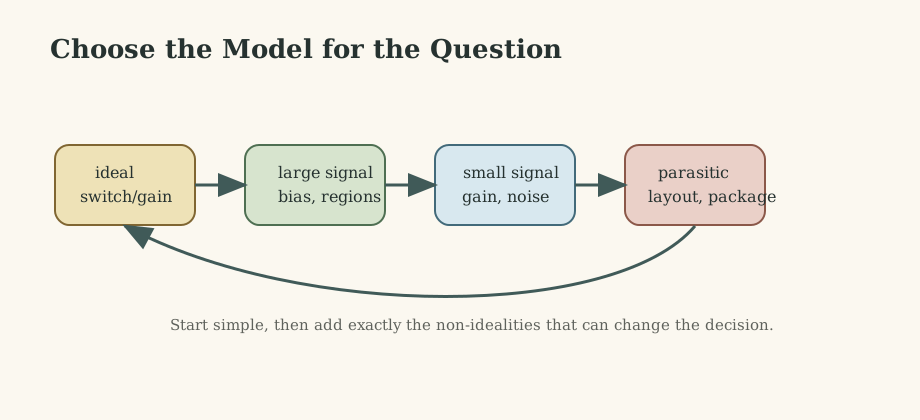
Electronics becomes manageable only when every circuit is treated as a model with assumptions, validity limits, and a clear purpose. A beginner often searches for a formula first, but practical design starts by asking what quantity actually controls failure, performance, and manufacturability in this operating range.
Kirchhoff’s Current Law and Kirchhoff’s Voltage Law are not just exam rules; they are conservation statements that remain useful even in complicated mixed-signal boards. KCL tracks charge continuity at nodes, and KVL tracks energy consistency around loops, so every later method is mostly an organized way to apply these two statements quickly.
For nodal analysis, a compact matrix form reduces hand mistakes and makes simulation consistent with analysis. If node voltages are unknowns, you can write a conductance matrix and solve linear systems repeatedly for sweeps and corners. This is where numerical methods support electronics rather than replacing intuition.
\[\sum_{k} \frac{V_i - V_k}{R_{ik}} + I_{source,i} = 0\]In loop or mesh analysis, current loops can simplify circuits dominated by voltage sources and series elements, but the method fails gracefully only when you keep polarity conventions explicit. Many sign errors in lab reports come from changing assumed current direction mid-derivation instead of letting the solved value become negative when the assumption was opposite to reality.
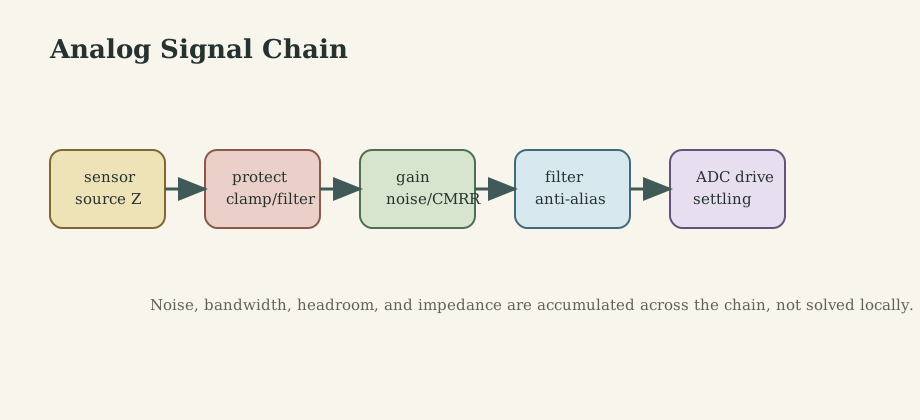
Thevenin and Norton transformations are practical because they separate network behavior from load behavior. That separation is exactly what happens in modular hardware design, where a sensor front end, a filter, and an ADC input stage are developed by different engineers. Equivalent source-plus-impedance models make those boundaries explicit.
\[V_{TH} = V_{OC}, \quad R_{TH} = \frac{V_{OC}}{I_{SC}}, \quad I_N = \frac{V_{TH}}{R_{TH}}\]Small-signal linearization is the bridge from nonlinear physics to predictable gain and bandwidth calculations. Around a bias point, you replace the nonlinear device by incremental parameters, which converts nonlinear differential equations into linear algebra and linear system theory. This is the same reason control design usually starts from operating points.
For transient behavior, a circuit with capacitors and inductors is an ODE system. You can hand-solve simple first-order forms, but design iterations usually rely on numerical integration. Forward Euler is intuitive but can be unstable at large time steps, while trapezoidal methods improve stability for stiff networks.
\[C\frac{dv}{dt} + \frac{v}{R} = i(t), \quad L\frac{di}{dt} + Ri = v(t)\]Nonlinear DC bias often requires iteration, and Newton-Raphson is the standard computational backbone behind SPICE-like solvers. The practical caution is that convergence depends on initial guesses, model smoothness, and limiting strategies, so simulation failed is often a modeling-quality issue rather than a mathematics issue.
\[x_{n+1} = x_n - \frac{f(x_n)}{f'(x_n)}\]The most useful engineering habit is to state assumptions next to the first equation: quasi-static, small-signal, room temperature, no saturation, ignore parasitics, or single-frequency approximation. When field failures happen, it is usually one broken assumption, not one broken formula.
A robust workflow is therefore: write physics constraints, choose abstraction level, solve, check units, check limits, and then challenge the result with extreme cases. If the model predicts impossible power, negative resistance where none should exist, or gain beyond transistor bandwidth, stop and revisit assumptions before tuning values.
2. Diodes and Nonlinear One-Way Elements
The diode is often introduced as a one-way switch, but real design value comes from understanding the I-V curvature, charge storage, and temperature sensitivity. Rectifiers, clamps, protection stages, and RF detectors all rely on details beyond the ideal arrow symbol.
Shockley behavior is the baseline model, and the exponential term explains why small voltage changes can create large current swings. Series resistance and high-level injection eventually bend the curve, so the simple law is accurate only within a practical range. That range must be checked when currents are large or temperature shifts are wide.
\[I_D = I_S\left(e^{\frac{V_D}{nV_T}} - 1\right), \quad V_T = \frac{kT}{q}\]In rectifier design, conduction angle, transformer impedance, and capacitor ripple current matter as much as nominal DC output voltage. A capacitor-input filter gives good average DC, but creates narrow high-current charging pulses, which increase heating, EMI, and transformer stress.
A first-order ripple estimate helps size bulk capacitance quickly, but should be followed by current stress checks. Many boards pass voltage checks yet fail reliability because capacitor RMS ripple current exceeds rating. Thermal life of electrolytics strongly depends on internal heating, so ripple current is a lifetime variable, not just a waveform detail.
\[\Delta V_{ripple} \approx \frac{I_{load}}{f_{rect} C}\]Zener and TVS diodes are common in protection paths, but protection quality depends on dynamic resistance, clamping speed, layout inductance, and energy rating. A correct part can still fail if loop inductance allows large overshoot before the diode fully conducts. Place protection components physically close to entry connectors and return paths.
Reverse recovery is a key non-ideal parameter in switching converters and fast digital power rails. A diode that stores charge during forward conduction can inject current spikes when switching polarity, raising loss and radiated emissions. Selecting Schottky, ultrafast, or synchronous-rectification topologies is often an EMI and efficiency decision, not only a DC drop decision.
Small-signal diode resistance is useful in analog linearization and detector analysis. Near a bias point, you can represent the diode by an incremental resistor, which makes gain and noise reasoning tractable. The caution is that this parameter changes with bias current and temperature, so fixed-value approximations drift in real operation.
\[r_d = \frac{nV_T}{I_D}\]Temperature behavior is central: forward voltage tends to decrease with increasing temperature, while leakage current rises strongly. This can induce thermal runaway in poorly biased systems, especially when diode conduction shares paths with transistor bias networks. Derating and thermal coupling assumptions must be explicit in high-power designs.
A practical clipping or clamping stage should be evaluated in three modes: normal operation, expected fault, and abnormal surge. Normal operation should avoid unnecessary loading, fault mode should keep downstream nodes in safe windows, and surge mode should remain below component pulse limits. Skipping one of these modes leads to fragile works-on-bench circuits.
In measurement circuits, diodes can corrupt low-level signals by leakage, capacitance, and nonlinear conduction near threshold. If precision is required, choose low-leakage parts, guard high-impedance nodes, and account for temperature-dependent offsets. This is where instrumentation-grade front ends diverge from textbook examples.
3. BJT and MOS/MOSFET Fundamentals
Transistors are controlled current or charge flow devices, but design quality depends on selecting the right control viewpoint for the application. BJTs are often current-driven in first explanations, while MOSFETs are treated as voltage-controlled devices, yet both are better understood through transconductance, output resistance, and stored charge.
For BJTs, collector current depends exponentially on base-emitter voltage in active operation. That gives high transconductance at modest currents, which is why BJTs can excel in low-noise analog front ends. The tradeoff is stronger temperature sensitivity and bias-point drift if the bias network is weak.
\[I_C \approx I_S e^{\frac{V_{BE}}{V_T}}, \quad g_m = \frac{I_C}{V_T}\]The familiar (\beta) parameter is useful for rough sizing, but robust bias should not depend strongly on a single (\beta) value, since it varies by device, current, and temperature. Emitter degeneration, current mirrors with proper compliance, and feedback-based biasing reduce this sensitivity.
MOSFET behavior is region-dependent: cutoff, triode, and saturation for long-channel approximations. In analog design, saturation means current set mainly by gate overdrive and channel-length modulation, not the same meaning as saturation in BJTs. Language precision prevents wrong intuition when switching between device families.
\[I_D \approx \frac{1}{2}\mu_n C_{ox}\frac{W}{L}(V_{GS}-V_{TH})^2(1+\lambda V_{DS})\]Threshold voltage is not a hard switch point; it depends on body bias, temperature, and process, and current still flows below threshold in exponential form. This matters for low-power and precision bias circuits, where subthreshold leakage or intentional subthreshold operation may dominate power behavior.
In power electronics, MOSFET (R_{DS(on)}), gate charge, and reverse recovery of body diode define conduction and switching tradeoffs. A lower (R_{DS(on)}) part can still perform worse if gate charge is too high for the chosen driver, leading to slower switching, extra loss, and thermal stress.
BJT switching stages must account for charge storage in deep saturation, which increases turn-off delay. This is why clamp techniques, Baker clamps, or avoiding deep saturation are used in fast logic and driver circuits. Ignoring stored charge can make timing margins disappear under temperature and lot variation.
Output resistance captures finite current-source quality. In analog gain stages, finite (r_o) directly reduces achievable gain, and in mirrors it causes current mismatch versus voltage swing. Early voltage for BJTs and channel-length modulation for MOSFETs play analogous roles here.
\[r_o \approx \frac{V_A}{I_C} \text{ (BJT)}, \quad r_o \approx \frac{1}{\lambda I_D} \text{ (MOS)}\]Noise behavior is another selection lever. BJTs often provide low voltage noise at higher currents, while MOSFETs may offer better input current characteristics for very high source impedances. Flicker noise, shot noise, and thermal noise should be tied to the source impedance and bandwidth requirement, not judged by a single datasheet number.
Bias design should be verified with corner analysis: process, voltage, and temperature variations. A nominally centered operating point can slide to cutoff or excessive dissipation at corners. Even a simple hand corner check catches many failures before simulation details consume time.
4. Single-Stage and Multistage Analog Amplification
An amplifier is not only about gain; it is about controlled transfer of information while limiting distortion, noise, and instability across the required bandwidth. A design that maximizes midband gain without headroom and bandwidth planning often fails system objectives. System-level requirements should therefore drive topology selection.
Common-emitter and common-source stages provide strong voltage gain, with inversion, and easy integration with resistive loads. Emitter or source degeneration trades gain for linearity, bias stability, and predictable input behavior. This trade is frequently beneficial in real instrumentation paths.
\[A_v \approx -g_m (R_D \parallel r_o) \text{ or } -g_m (R_C \parallel r_o)\]Input and output coupling networks define low-frequency behavior, while internal capacitances and Miller multiplication shape high-frequency roll-off. Designers should think in poles and zeros, not isolated components, because each stage changes source/load conditions for the next stage. Cascading without impedance planning invites unintended bandwidth loss.
Multistage amplifiers require gain distribution. Pushing all gain into one stage can worsen linearity and stability, whereas staged moderate gains with buffering provide more robust behavior. The right split depends on noise placement, headroom, and required output swing.
Bode plots are practical communication tools. They show not only nominal response, but phase margin trends, compensation effects, and sensitivity to process spread. A flat gain line is not enough; phase behavior predicts whether transients ring, settle, or diverge.
\[\mathrm{GBW} \approx A_{CL} \cdot f_{BW} \text{ (single-pole approximation)}\]Distortion management requires identifying dominant nonlinearity sources. Transistor transconductance curvature, output swing limits, and load interactions each contribute harmonics. Local feedback, emitter/source degeneration, and proper bias current can suppress distortion without excessive complexity.
Noise budgeting should start at the input and propagate to output. Equivalent input noise density, source impedance, and bandwidth determine total integrated noise. Designs that look clean in DC can fail at low signal levels if 1/f noise and broadband terms are not budgeted.
A useful method is to separate noise into contributions: source, active device, resistors, and supply coupling. Then identify which contributor dominates in the band of interest. Only then should components be upgraded; otherwise cost increases without measurable benefit.
Amplifier stability in mixed-signal systems depends on power supply and grounding quality too. Poor decoupling, long return paths, and digital switching currents can modulate analog bias nodes, appearing as unexplained gain drift or spurious tones. This is why analog and layout decisions cannot be separated.
A compact design example is a sensor preamp with required gain of 100 over 1 kHz bandwidth. One approach is two gain stages of 10 each, inter-stage high-pass filtering for offset management, and final low-pass anti-alias shaping. This arrangement usually offers better headroom and tuning flexibility than a single aggressive stage.
5. Op-Amps in Reality: From Ideal Rules to Deployable Circuits
Ideal op-amp rules are powerful mental shortcuts, but practical circuits fail when finite open-loop gain, finite bandwidth, input bias currents, and output current limits are ignored. Design should begin with ideal equations, then immediately add non-ideal checks before freezing values.
The closed-loop gain relation with finite open-loop gain explains why high closed-loop accuracy requires margin. If open-loop gain falls at frequency, closed-loop transfer deviates, phase shifts, and dynamic errors appear. This is why DC precision and AC fidelity are linked by the same internal gain profile.
\[A_{CL} = \frac{A_{OL}}{1 + A_{OL}\beta}\]Slew rate is a large-signal limit, not visible in small-signal bandwidth calculations. A circuit can show correct sine response at small amplitude yet distort badly on fast steps. Always check required (dV/dt) against datasheet slew-rate limits, especially in DAC reconstruction and actuator drive interfaces.
\[\left|\frac{dV_o}{dt}\right|_{max} \le SR\]Input common-mode range and output swing constraints are frequent integration errors. Rail-to-rail labeling is often conditional, with degraded performance near rails. When the signal chain includes sensors near ground and ADC references near rails, headroom must be verified over temperature and load.
Active filters are where op-amp non-idealities become practical. Finite GBW shifts cutoff, finite output drive changes Q, and component tolerances move pole locations. Filter prototypes should include sensitivity checks, not only nominal transfer plots.
Instrumentation conditioning often uses differential stages or instrumentation amplifiers. CMRR is a system property, not just an amplifier property, because resistor matching, layout symmetry, and source imbalance all contribute. A high-CMRR device can underperform with weak external matching.
Offset and drift are critical in low-level measurement. Auto-zero and chopper amplifiers reduce low-frequency offset, but may introduce ripple artifacts and switching spikes. Selecting architecture is therefore signal-band dependent, not simply lowest offset wins.
Feedback network design should include resistor noise, loading, and bias-current-induced errors. Very large resistor values reduce current draw, but increase thermal noise and bias-induced offset. Balanced resistor choices often produce better overall performance.
Compensation strategies, including dominant-pole, lead, or feed-forward techniques, are fundamentally phase-margin control methods. The target is not mathematical elegance, but predictable transient response under production variation and load diversity. A stable prototype with narrow margin is still a risk.
For practical validation, measure DC transfer, small-signal frequency response, and large-signal step response. If all three agree with expected behavior, the op-amp stage is usually ready for integration. If one diverges, identify whether the cause is model mismatch, layout parasitics, or measurement setup loading.
6. Digital Circuits, Timing Integrity, and FPGA Context
Digital design is often treated as logic algebra, but field failures are commonly timing, noise, and interfacing problems rather than Boolean errors. A robust digital system must satisfy voltage thresholds, timing windows, and signal integrity simultaneously.
Logic compatibility starts with guaranteed VIH/VIL and VOH/VOL levels, not nominal values. When interfacing different families or voltage domains, margin must be checked at worst-case current and temperature. Ignoring guaranteed limits creates intermittent faults that appear only on certain boards.
Propagation delay, rise/fall asymmetry, and loading determine practical operating frequency. High fanout raises edge delay and power consumption, and long traces add distributed effects. Clock trees and high-speed enables should be treated as controlled interconnect structures, not ideal wires.
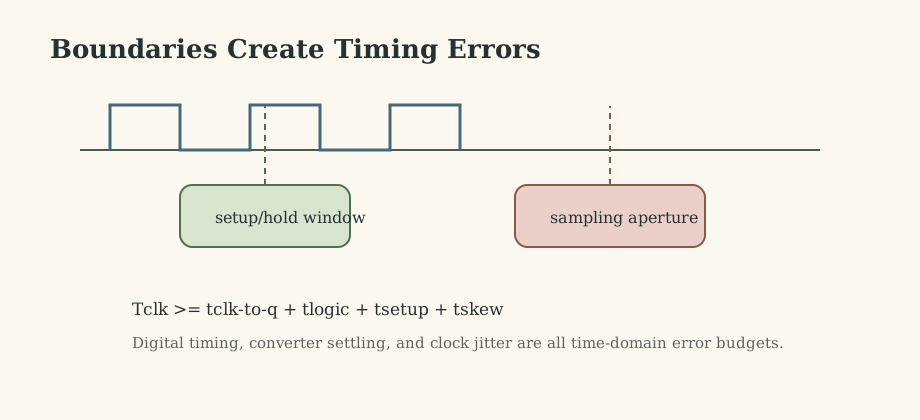
Synchronous design relies on setup and hold constraints around clock edges. Violations do not always crash immediately; they may create metastability and sporadic logic corruption. Design reviews should include timing budget tables, not only schematic correctness.
\[T_{clk} \ge t_{clk\rightarrow q} + t_{logic} + t_{setup} + t_{skew}\]Metastability is probabilistic, so mitigation means making failure probability acceptably low, not mathematically zero. Two-flop synchronizers, CDC protocols, and handshake designs are practical tools. The right method depends on data rate, latency tolerance, and consequence of lost samples.
\[MTBF \propto e^{\frac{T_{res}}{\tau}}\]Debouncing and input conditioning matter even for slow human interfaces. Without filtering, mechanical bounce produces multiple edges and false events, which may propagate into control loops and state machines. RC plus Schmitt triggers, or digital debouncing with timed confirmation, are standard defenses.
In FPGA-based systems, architecture partitioning is central. Use FPGA fabric for deterministic parallel data paths, filters, protocol engines, and low-latency processing, while software handles configuration, state supervision, and complex decision logic.
A frequent mistake is mapping variable-latency software assumptions into fixed-latency hardware pipelines. FPGA logic rewards explicit timing and throughput planning. Block RAM, DSP slices, and clock domains should be budgeted early, otherwise late-stage synthesis surprises can force major redesign.
Signal integrity on digital edges links directly to PCB geometry. If trace length approaches edge-transition electrical length, reflection and ringing become visible. Series damping, proper termination, and controlled impedance traces prevent overshoot-induced logic errors.
\[\Gamma = \frac{Z_L - Z_0}{Z_L + Z_0}\]Digital design quality is therefore not only HDL correctness. It is the combined discipline of logic, timing closure, power integrity, and physical interconnect control. The best teams run these checks in parallel, not sequentially at the end.
7. Mixed-Signal Bridge: ADC, DAC, and Reference Strategy
The analog-to-digital and digital-to-analog boundary is where many systems lose performance silently. Designers may optimize analog and digital blocks separately, then discover the converter stage dominates noise, latency, and calibration burden. Mixed-signal design should be treated as a first-class architecture layer.
For ADCs, resolution alone is incomplete; ENOB, SNR, SFDR, and input bandwidth matter equally. A 16-bit converter in a noisy layout can deliver far less effective resolution than expected, so front-end noise and reference quality must be budgeted from the beginning.
\[\Delta = \frac{V_{FS}}{2^N}, \quad SNR_{ideal} \approx 6.02N + 1.76\ \text{dB}\]Sampling theorem guidance is necessary but not sufficient. Nyquist rate prevents aliasing of band-limited signals, but real signals often include out-of-band interference. An anti-alias filter must therefore be physically close to the ADC input, with component tolerance and source impedance considered.
Converter input architecture affects interface design. SAR ADCs with switched-capacitor fronts can draw dynamic charge pulses, so source impedance and driver settling become critical. Ignoring acquisition-time settling causes code-dependent errors that are hard to diagnose in firmware.
DAC design has symmetric challenges. Glitch energy, output settling, and reference noise shape reconstructed waveform quality. For control outputs, monotonicity and low-frequency linearity may matter more than raw update rate. For waveform generation, update timing jitter and filtering dominate spectral purity.
Reference design is often the hidden limiter. A low-noise reference still fails if routing injects digital return currents or thermal gradients. Place and route references like precision analog components, with guarded nodes, clean returns, and local decoupling matched to converter transients.
Grounding strategy in mixed-signal boards is about return current paths, not symbolic split everything rules. Aggressive splits can force return detours and worsen coupling. A controlled continuous plane with partitioned current loops often performs better than hard cuts.
Timing architecture connects converter specs to system behavior. Sample-clock jitter directly degrades high-frequency SNR, and asynchronous data handoff can add variable latency. In closed-loop systems, latency budget is as important as resolution budget.
\[SNR_{jitter} \approx -20\log_{10}(2\pi f_{in} t_j)\]Calibration uses numerical methods in practical ways. Two-point and multi-point fits compensate gain and offset, while polynomial or piecewise fits address nonlinear sensors. Least-squares residual checks prevent overfitting, which can otherwise worsen accuracy outside calibration points.
\[\hat{\theta} = (X^T X)^{-1}X^T y\]A strong mixed-signal design process includes: front-end range planning, noise budget, reference architecture, clock integrity, and firmware calibration strategy. Treating conversion as only a component-selection step usually creates late surprises.
8. Power Electronics and Actuation Interfaces
Power electronics is the discipline of controlling energy flow efficiently, reliably, and electromagnetically cleanly. Unlike small-signal analog stages, power stages are dominated by switching transitions, parasitics, and thermal constraints, so circuit theory and physical implementation are inseparable.
Buck, boost, and buck-boost topologies are foundational. Their duty-cycle relations give first-pass feasibility, but real performance depends on inductor ripple, switch timing, loss mechanisms, and control-loop stability. A correct duty ratio does not guarantee a stable or efficient converter.
\[V_o \approx D V_{in} \text{ (buck)}, \quad V_o \approx \frac{V_{in}}{1-D} \text{ (boost)}\]Inductor and capacitor sizing starts from ripple targets, then expands to RMS current, ESR heating, and transient response. Designs that satisfy average equations can fail thermal limits during start-up or load steps. Always examine worst-case conditions, not only nominal steady state.
\[\Delta I_L \approx \frac{(V_{in}-V_o)D}{Lf_s}, \quad \Delta V_o \approx \frac{\Delta I_L}{8f_s C}+\Delta I_L\cdot ESR\]Switching losses come from overlap of voltage and current during transitions, and from charging/discharging parasitic capacitances and gate charge. Higher switching frequency reduces passive size, but increases switching loss and EMI pressure. Optimal frequency is therefore a system trade, not a universal maximum.
Gate driving is a control problem in itself. Insufficient drive creates slow edges and heat, while overly aggressive drive increases ringing, overshoot, and radiated noise. Gate resistors, Kelvin source connections, and tight driver loops are practical tuning levers.
Synchronous rectification improves efficiency at low output voltages, but requires careful dead-time control to avoid shoot-through. Body diode conduction during dead-time also introduces loss and reverse-recovery stress. Controller choice should be tied to expected load range, not just peak efficiency marketing points.
Thermal design converts electrical losses into temperature rise predictions. Junction temperature margins should include ambient variation, airflow uncertainty, and enclosure effects. A bench-top open-air success can overheat in final product packaging without explicit thermal margin.
\[T_J = T_A + P_{loss}\,(\theta_{JA})\]Power stages for motors add back-EMF, inductive kick, and control dynamics. Freewheel paths, current sensing, and overcurrent protection must be designed at architecture level. A missing current-limit strategy turns minor stalls into catastrophic failures.
Control-loop compensation for converters and drives should be validated in both frequency and time domains. Gain/phase margins predict robustness, while load-step tests reveal practical settling and overshoot. Stable but slow loops may fail application response requirements, so control tuning must reflect mission dynamics.
9. Motors, Sensors, and Closed-Loop Instrumentation
Electromechanical systems become predictable only when electrical, mechanical, and sensing dynamics are modeled together. Separating motor, driver, and sensor design into isolated tasks often leads to oscillation, noise sensitivity, and inefficient operation. Closed-loop thinking should begin at concept stage.
For DC motors, voltage equation and torque relation capture core behavior. Electrical time constants and mechanical inertia interact, so controller bandwidth cannot be chosen from electronics alone. A fast electrical loop with unmodeled mechanics can amplify resonance and noise.
\[V = Ri + L\frac{di}{dt} + K_e\omega, \quad \tau = K_t i\]BLDC and PMSM systems add commutation strategy and position information requirements. Sensorless methods reduce hardware, but depend on back-EMF observability, which degrades at low speed. Hall, encoder, or resolver feedback adds cost but improves low-speed controllability.
Current sensing options include shunt, Hall, and magnetic field sensors. Shunt sensing is cost-effective and linear, but requires careful common-mode range handling and Kelvin routing. Hall methods provide isolation and lower insertion loss, with tradeoffs in bandwidth and offset drift.
Sensor chains should be specified end-to-end: transduction principle, excitation, conditioning, conversion, and calibration. A good sensing element can still produce poor system data if excitation stability or front-end CMRR is weak. Measurement engineering is system engineering.
Bridge sensors, thermistors, strain gauges, and piezoresistive elements all need excitation decisions. Constant voltage, constant current, or ratiometric schemes each shift sensitivity to supply variation. Selecting excitation style is a first-order accuracy decision, not implementation detail.
Filtering in sensor loops balances noise rejection and dynamic response. Analog prefiltering prevents aliasing and out-of-band overload, while digital filters shape residual noise and latency. Controller performance should be evaluated with total loop delay, not isolated filter responses.
Calibration maps raw readings to physical units. Linear calibration is often sufficient for narrow operating windows, while polynomial or table methods handle nonlinear sensors. Residual analysis and cross-validation reduce the risk of calibration that fits lab points but fails in field use.
\[y = a_0 + a_1x + a_2x^2 + \cdots\]Fault detection is essential in actuator systems. Open-wire, stuck-at, out-of-range, and rate-of-change checks can detect many failures early. A well-designed system should degrade gracefully, for example by entering safe torque limits instead of hard shutdown when one sensor channel fails.
Instrumentation reliability also depends on wiring and connector strategy. Differential signaling, shield termination policy, and connector pin assignment influence noise immunity and maintenance errors. Design choices that simplify service diagnostics often reduce lifecycle cost more than component savings.
10. EMC, EMF, RF, and Physical Interconnect Discipline
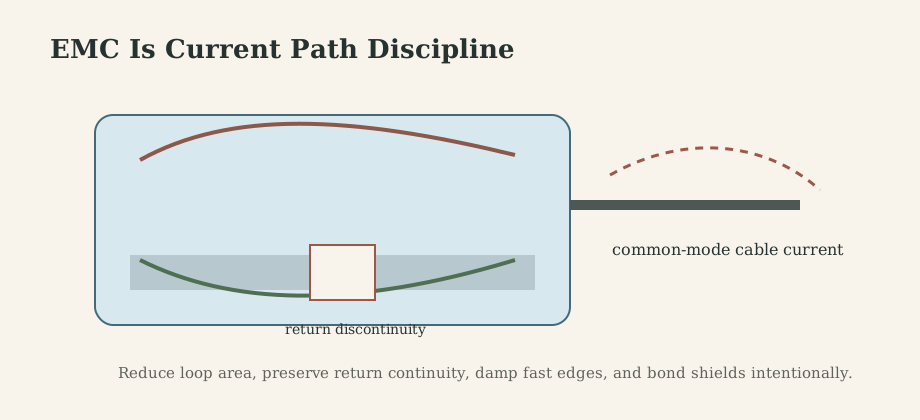
EMC is not an afterthought compliance activity; it is a design discipline that starts when current loops are first sketched. Most emissions and susceptibility issues come from predictable coupling mechanisms, so early physical planning is more effective than late shielding patches.
Coupling paths are typically conductive, capacitive, inductive, or radiative. Each path has a matching mitigation strategy: impedance control, field cancellation, spacing and shielding, or bandwidth limiting. Naming the dominant path first prevents random mitigation attempts.
Common-mode currents are frequent radiators, especially when cable shields and chassis references are poorly managed. Differential signal quality can look excellent while common-mode noise drives emissions failures. Therefore return path design must include cable and enclosure current routes, not only PCB traces.
Fast switching edges expand spectral content. A converter switching at hundreds of kilohertz can still violate limits at tens of megahertz due to edge harmonics. Slew-rate control, loop minimization, and damping of ringing are practical EMC levers that often outperform brute-force filtering.
RF thinking helps even in non-RF products. At high edge rates, interconnects behave as transmission lines, and reflections or mode conversion can corrupt both emissions and functional behavior. Controlled impedance and reference continuity are key when rise times are short.
\[Z_0 \approx \sqrt{\frac{L'}{C'}}, \quad v_p = \frac{1}{\sqrt{L'C'}}\]Skin effect increases AC resistance at high frequency, raising loss and altering current distribution in conductors and shields. This affects filter effectiveness, ground impedance, and cable behavior. Understanding skin depth helps explain why thicker wire is not always the right RF/EMC fix.
\[\delta = \sqrt{\frac{2}{\omega\mu\sigma}}\]Shielding strategy depends on frequency and coupling mode. Electric-field shielding can work with conductive enclosures and proper bonding, while magnetic low-frequency shielding may require high-permeability materials and loop-area reduction. A shield that is not bonded correctly can become an antenna.
Grounding policy should be defined by return current behavior. Single-point grounding can help low-frequency analog domains, while multi-point or chassis-bonded strategies are often necessary at high frequency. Mixed policies without explicit boundary rules create unpredictable noise paths.
Cable and harness design is part of EMC. Twisted pairs, shield termination choices, connector shell bonding, and separation from noisy power paths strongly influence susceptibility. The cheapest EMC improvement is often harness routing discipline, not additional filters.
Pre-compliance measurement saves development time. Near-field scans, LISN-based conducted checks, and basic immunity injection tests reveal dominant issues early. By the time formal compliance testing starts, major failure modes should already be understood and mitigated.
11. EDA-to-Hardware Workflow, Wiring, and Verification
EDA is not only drawing schematics; it is the process framework that preserves intent from concept to manufacturable hardware. A reliable workflow links requirement, schematic, layout, BOM, and test strategy with traceability, so late changes do not silently break assumptions.
Schematic capture should encode electrical intent clearly: net naming, power-domain labeling, connector pin functions, and test points. Readable schematics reduce integration errors and accelerate debugging, especially when multiple teams share ownership.
Constraint-driven PCB design is where reliability is won. Stackup definition, impedance targets, clearance rules, return-path continuity, and thermal copper planning should be established before detailed routing. Routing without constraints produces visually clean but electrically weak boards.
Power integrity requires decoupling hierarchy. Bulk capacitors support low-frequency load changes, while local high-frequency capacitors suppress fast transients near IC pins. Placement distance and via inductance can dominate performance, so capacitor value alone is insufficient.
Wiring and harness decisions belong in system-level CAD and review, not only in assembly instructions. Pinouts should separate sensitive analog inputs from switching nodes, allocate shield and drain strategies, and include service-safe keying to prevent field misconnection. Connector architecture is part of circuit design.
DFM and DFT discipline should be embedded early. DFM checks solderability, clearances, component orientation, and assembly risk. DFT ensures probing, boundary access, and controllability/observability for production and service diagnostics. A board that cannot be tested efficiently is an expensive board.
FPGA and MCU co-design needs explicit interface contracts. Clocking, reset behavior, startup sequencing, and communication protocols should be specified in timing terms, not vague software assumptions. Integration failures often occur at power-up transitions where each domain expects the other to be ready first.
Simulation is most useful when tied to concrete questions. Use SPICE-level checks for bias, gain, noise, and transient stress; use numerical sweep automation to test tolerance corners. Monte Carlo and worst-case analyses convert uncertain component spreads into quantified risk.
Numerical methods from general engineering courses become practical here. Root finding supports bias convergence checks, ODE solvers predict startup dynamics, and interpolation methods support component model approximation when datasheet tables are sparse. The objective is decision support, not mathematical ornament.
Bring-up should follow a staged protocol: power rails first, clock and reset second, basic interfaces third, then full functional tests. Skipping sequence discipline increases risk of damaging components and obscures root causes when issues appear. Structured logs are essential for repeatable debugging.
Troubleshooting effectiveness depends on observability planning. Add sense resistors, status LEDs where useful, test pads, and accessible debug headers. The small area cost of diagnostics usually pays back many times during validation and maintenance.
12. Packaging, Reliability, and Integration Checklist
Packaging translates silicon and components into physically deployable systems, but it also introduces parasitics, thermal paths, mechanical stress, and aging behavior. A design that is electrically strong on paper can degrade in package and assembly context if these effects are ignored.
Package parasitics include lead/bond inductance, pin capacitance, and thermal resistance. These terms alter high-speed transitions, converter stability, and RF behavior. Modeling package effects early avoids late-stage surprises where measured behavior diverges from ideal simulations.
\[Z_{parasitic}(s) = sL_p + \frac{1}{sC_p} + R_p\]Thermal cycling creates fatigue in solder joints and interconnects due to expansion mismatch. Reliability planning must include expected mission temperature cycles, not just maximum absolute temperature. Products with frequent start-stop operation often fail from cycle fatigue before semiconductor wear-out limits are reached.
Arrhenius-based acceleration models and empirical fatigue laws support life estimation. These models are approximations, but they provide a disciplined way to compare design options and screening strategies. Without such models, reliability decisions become anecdotal.
\[AF = \exp\left[\frac{E_a}{k}\left(\frac{1}{T_{use}}-\frac{1}{T_{stress}}\right)\right]\]Moisture sensitivity, corrosion risk, and contamination control are practical packaging concerns. Flux residues, ionic contamination, and enclosure breathing can create leakage paths and intermittent faults. Cleanliness processes and conformal coating decisions should be tied to environment class and maintainability.
Derating is a systems decision, not a blanket percentage. Voltage, current, power, and temperature derating should reflect consequence of failure, repair cost, and mission criticality. A highly accessible consumer device and a sealed industrial controller justify different derating policies.
Mechanical integration influences electronics reliability. Board mounting, standoff placement, vibration exposure, and connector strain relief affect solder joint life and intermittent contact risk. Good mechanical-electrical co-design reduces random field returns that are otherwise hard to reproduce in labs.
An integration checklist for release should include: functionality across temperature, power transients, EMC margin, sensor calibration retention, clock/timing margin, and safe-state behavior on detected faults. Passing nominal tests alone is not enough for deployment confidence.
Failure analysis feedback must loop into design rules. If repeated faults show cracked solder at heavy connectors, update placement, anchoring, and strain strategy. If converter failures correlate with surge events, revise protection and layout current loops. Reliability improves when evidence updates standards, not only individual designs.
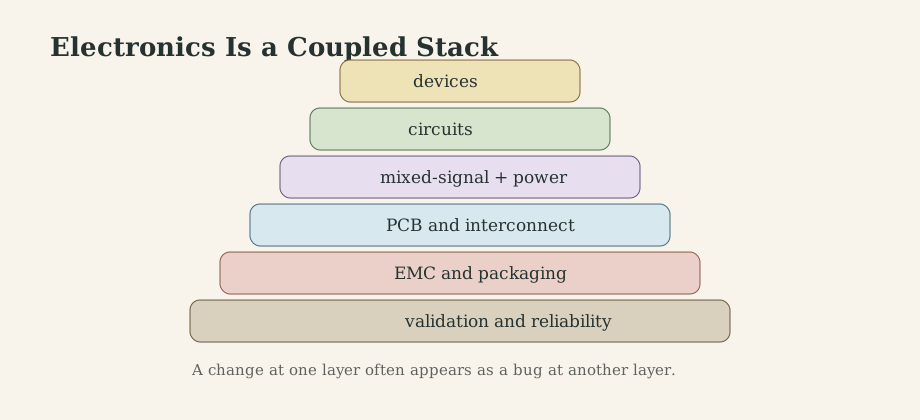
The final engineering message is that electronics is a coupled discipline. Device physics, circuit design, digital timing, power conversion, EMC, EDA flow, and packaging reliability are one system. The best results come from iterative cross-domain checks, where each design decision is tested against electrical, thermal, mechanical, and manufacturing realities before release.